





Emergency location service
Find the people who need your help, faster.

Innovation that helps you save more lives.
Today, over 80% of emergency calls come from mobile devices. But locating these callers can be tough—especially with inexact tools like cell tower triangulation and GPS.
Google created Android Emergency Location Service (ELS) to quickly send more accurate location and, in some regions, contextual information to emergency services when a user calls or texts an emergency number.
Google created Android Emergency Location Service (ELS) to quickly send more accurate location and, in some regions, contextual information to emergency services when a user calls or texts an emergency number.

Improved location accuracy that reduces emergency response time by one minute can save over 10,000 lives annually.1
United States Federal Communications Commission
PS Docket No. 07-114

What is ELS?
ELS is a tool available on Android devices that allows first responders to locate emergency callers and texters faster and with greater accuracy, using a combination of GPS, cell, Wi-Fi and sensor data. In some regions, ELS can also provide contextualized information, such as the device language, so that first responders can act faster.
We partner with governments, mobile operators and public safety vendors to launch ELS in a country or region. The partner is responsible for setting up and maintaining an endpoint that can receive ELS location information when a user contacts an emergency number.
We partner with governments, mobile operators and public safety vendors to launch ELS in a country or region. The partner is responsible for setting up and maintaining an endpoint that can receive ELS location information when a user contacts an emergency number.
Key benefits.
-
Works on over 99% of Android devices.
ELS works on over 99% of active Android devices with Google Play services support—no new hardware or activation required.
-
Built with privacy in mind.
Google does not view the location sent to the endpoint. Plus, users can turn off ELS in Settings.
-
Provides the caller’s device language setting.
So Emergency Services can ask for a translator right away.
-
Free-to-use.
Google does not charge for ELS. Our goal is make it easier for first responders to locate Android users in an emergency, and improve the state of emergency services around the world.


Case study: Austrian Alps
Helicopter rescuer saves paraglider in Austrian Alps using ELS.

Link to Youtube Video (visible only when JS is disabled)
It was simple to implement and it’s proving to be reliable, accurate and fast… For countries thinking of implementing ELS, my advice would be to get on with it—the solution works.
Ben Quay
Former Program Director, New Zealand Ministry of Business, Innovation and Employment
Case study: Coburg, Germany
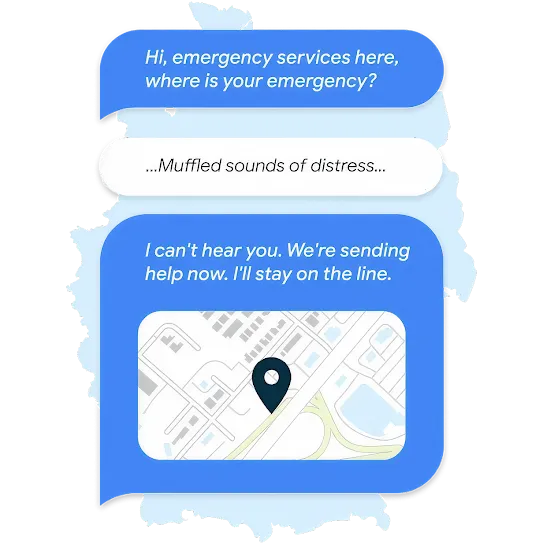
In Germany, ELS helps save a caller who can’t answer.
The 112 integrated control center in Coburg, Germany received a call from a woman suffering a seizure. Although the emergency caller was unable to communicate and hung up, ELS was still able to send the needed location information to the dispatcher. First responders arrived on the scene in just enough time to save the woman’s life.
Google saw an opportunity to help solve one of the biggest problems of emergency services… As a result, around 1 billion phones worldwide are ELS-enabled.
Garu Machado
Executive Director, European Emergency Number Association